Altaf Hussain Wani examines growing concerns over demolitions of Muslim homes and religious sites in India, questioning whether administrative action is being used as punishment before judicial proceedings. The article explores human rights, religious freedom, Supreme Court safeguards and the importance of protecting the rule of law.

Tag: Kashmir
Security Restrictions in Srinagar and Along Srinagar-Jammu Highway Raise Concerns Over Freedom of Movement
Intensified security checks and SOG deployment in Srinagar and along the Srinagar-Jammu highway have reportedly disrupted commuters' movement. Altaf Hussain Wani has raised concerns over the impact of these measures on fundamental human rights.
The Illusion of the Ballot: Breaking the Carousel of Control
KIIR Chairman Altaf Hussain Wani argues that elections in Indian-occupied Jammu and Kashmir are not a substitute for the people's fundamental right to self-determination.
His analysis examines decades of political engineering, the abrogation of Article 370 and the need to fulfil UN resolutions on Kashmir.
India’s Crumbling Facade: Kashmir and the World That Is No Longer Fooled
India’s democratic image faces growing international scrutiny amid allegations of human rights violations, military operations and restrictions on dissent in Indian Illegally Occupied Jammu and Kashmir. Muhammad Ibrahim Bhatti examines the Kashmir dispute, Pakistan’s diplomatic stance and the international community’s responsibility.
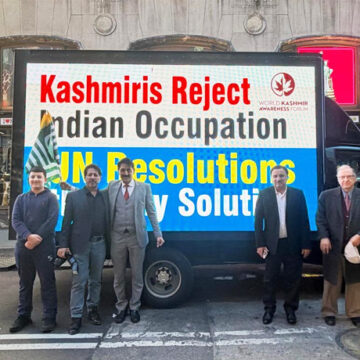
Digital Trucks Carry Kashmir Messages Across New York on 79th Anniversary of October 27
Digital advertising trucks carrying messages about Kashmir's disputed status, human rights and right to self-determination traveled through Times Square and other prominent locations in New York on October 27, 2026.
Organized by the World Kashmir Awareness Forum, the campaign called for renewed international engagement, dialogue and a peaceful settlement involving India, Pakistan and the people of Jammu and Kashmir.
Kashmir between Realpolitik and International Law: The Unfulfilled Promise of 1947
The Kashmir dispute highlights the gap between international legal principles and geopolitical realities, raising questions about self-determination, international commitments and global accountability. This analysis examines why the promise associated with 1947 remains unfulfilled and why a peaceful, politically legitimate solution is essential for regional stability.
27 October: The Plebiscite, the Voter Register and Kashmir’s Future.
On 27 October, Kashmir Black Day, Zainab Noor examines the long-pending UN-supervised plebiscite and argues that protecting the historical voter register is essential to a credible vote on Kashmir’s future.
The article explores the legal, demographic and diplomatic challenges surrounding Kashmir’s right to self-determination and proposes preserving documentary evidence of state-subject status.
27 October 1947: The Beginning of Kashmir’s Unfinished Struggle.
The events of 27 October 1947 remain central to the unresolved Kashmir dispute. Explore the controversy surrounding the Instrument of Accession, the UN’s role, and the continuing demand for self-determination.
The Standstill Agreement and the Contested October.
Muhammad Waleed Akhtar examines the 1947 Standstill Agreement, Maharaja Hari Singh’s accession decision and the unfulfilled plebiscite commitment that remains central to debates over Kashmir’s political status.
The Judicialization of Repression: Silencing Dissent in Occupied Kashmir : Altaf Hussain Wani.
Altaf Hussain Wani examines prolonged detentions, anti-terror laws and the judicial process in Occupied Kashmir, arguing that legal mechanisms are increasingly being used to suppress political dissent.