

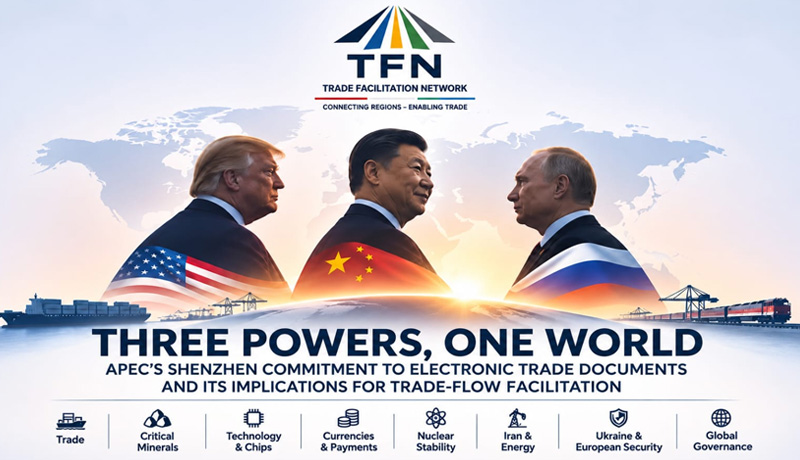
New regional push focuses on cross-border recognition of electronic bills of lading and invoices, legal compatibility and digital connectivity across international supply chains
BRUSSELS/SHENZHEN, (Unib Rashid) – The Asia-Pacific Economic Cooperation (APEC) meetings in Shenzhen have placed cross-border recognition of electronic trade documents at the centre of regional efforts to advance paperless trade, a development that could have significant implications for international commerce, logistics and supply-chain operations.
In its Joint Ministerial Statement, APEC ministers reaffirmed their commitment to facilitating paperless trade, specifically highlighting electronic bills of lading and electronic invoices. They also encouraged member economies to align their domestic legal frameworks with the principles of the United Nations Commission on International Trade Law (UNCITRAL) Model Law on Electronic Transferable Records (MLETR).
The statement further emphasised capacity building and stronger cooperation between the public and private sectors through the APEC Centre of Excellence for Paperless Trade (ACCEPT).
The initiative addresses a major challenge facing digital international trade: ensuring that electronic documents issued in one jurisdiction are legally recognised, trusted and accepted by authorities, banks, carriers and commercial partners in another.
Legal recognition remains a key challenge
Although electronic documentation is already widely used by businesses, shipping companies, financial institutions and customs administrations, its legal recognition and acceptance remain inconsistent across countries.
Differences in national legislation, authentication requirements, technical standards and institutional procedures can prevent electronic records from performing the same legal functions as their paper-based equivalents.
The UNCITRAL Model Law on Electronic Transferable Records, adopted on July 13, 2017, provides a legal framework for electronic versions of transferable documents such as bills of lading, bills of exchange, promissory notes and warehouse receipts.
A central principle of the framework is functional equivalence, under which an electronic record should be capable of performing the legal function of its paper-based counterpart.
For this purpose, systems must be able to identify the authoritative electronic record, maintain its integrity, establish exclusive control and enable the transfer of control where required.
However, MLETR is a model law rather than an international treaty. It does not automatically apply across borders. Individual jurisdictions must establish their own legal frameworks, and the extent of implementation varies.
UNCITRAL’s published status information reports legislation based on or influenced by MLETR in 13 States and jurisdictions. This does not mean that every jurisdiction has adopted the complete model law or recognises all categories of electronic transferable records.
Different documents require different legal treatment
The transition to paperless trade also requires a clear distinction between electronic transferable records and other electronic transport or regulatory documents.
Electronic bills of lading may represent rights that can be transferred through control of the record. By contrast, digital waybills, electronic road consignment notes, cargo manifests, customs declarations and delivery records generally serve different operational and regulatory purposes.
For example, an electronic road waybill can provide information about a carriage arrangement, identify cargo and parties, support regulatory compliance and record transport activities. Its legal effect depends on the applicable law and contractual framework.
The e-CMR framework provides a specific legal basis for using electronic consignment notes in international road transport under the CMR Convention.
A successful paperless trade environment will therefore require legal and technical arrangements that recognise the different functions of individual documents rather than treating all electronic records as legally interchangeable.
TFN highlights the importance of complete trade-flow facilitation
The Shenzhen developments also carry significance for the Trade Facilitation Network (TFN), which advocates a broader approach to trade facilitation by connecting commercial transactions with the physical movement and delivery of goods.
Under TFN’s Trade-Flow Facilitation concept, the process is viewed through two interconnected levels.
The first, Transaction Enablement, covers the commercial and financial foundations of trade, including contracts, purchase orders, invoices, bills of lading, banking, payments, trade finance, insurance and the exchange of commercial information.
The second, Trade-Flow Mobility, focuses on the operational movement of goods. It includes cargo readiness, vehicle and carrier availability, transport documentation, border processing, cargo release, multimodal connections and delivery confirmation.
According to TFN’s analysis, legally recognised electronic documents can support both levels by reducing documentary uncertainty, improving information exchange and strengthening coordination between commercial and logistics participants.
The organisation argues that completing a commercial transaction does not necessarily mean that goods can move efficiently. Cargo movement may still be delayed if transport providers are unavailable, documents are not recognised, border authorities cannot verify information or different transport systems cannot exchange the necessary records.
Interoperability essential for international logistics
The benefits of digital trade documents will depend heavily on interoperability between countries, institutions and transport systems.
This requires cooperation in several areas, including compatible national laws, common technical standards, institutional procedures for verifying electronic records, reliable authentication and continuity of information across road, rail, maritime and air transport.
The APEC Trade Digitalization Cooperation Framework for 2027–2030 provides a wider basis for regional cooperation. Its areas of focus include electronic authentication and signatures, domestic electronic transaction frameworks, paperless trade, customs digitalisation, electronic invoicing and electronic payments.
For international transport, the potential benefits include more efficient document transfers in maritime shipping, improved information exchange in road and rail transport, better coordination across multimodal supply chains and stronger support for customs risk assessment and border processing.
Banks and insurers may also benefit from more reliable electronic records for trade finance and insurance arrangements, subject to applicable legal and contractual requirements.
Implementation remains the next major test
Despite the policy progress, the Shenzhen commitment does not establish a single regional electronic-document system or automatically change national laws.
APEC cooperation is voluntary and non-binding, taking account of differences in national capacities, policy priorities and levels of digital readiness.
Turning the commitments into practical results will require countries to review domestic legislation, develop compatible recognition mechanisms, promote common authentication and data-exchange standards, strengthen cross-border cooperation and involve customs authorities, transport operators, financial institutions and private businesses.
Capacity building and knowledge exchange through the APEC Centre of Excellence for Paperless Trade will also be important, particularly for economies and businesses at earlier stages of digital development.
From digital documents to connected trade systems
In its assessment, TFN describes the Shenzhen commitment as an important step towards a more integrated international trading environment.
The wider objective, it argues, should extend beyond replacing paper documents with electronic versions. Digital systems must connect the legal, commercial, financial, regulatory and physical dimensions of trade.
The next stage of trade facilitation will depend not only on faster customs procedures or digital documentation, but also on the ability to connect transactions, financial services, transport operations, border authorities and international corridors.
The central challenge is to facilitate the complete movement of trade — from the initial commercial transaction to the final delivery of goods.
Trade Facilitation Network (TFN)
Connecting Regions. Enabling Trade.
Leave a Reply
You must be logged in to post a comment.