

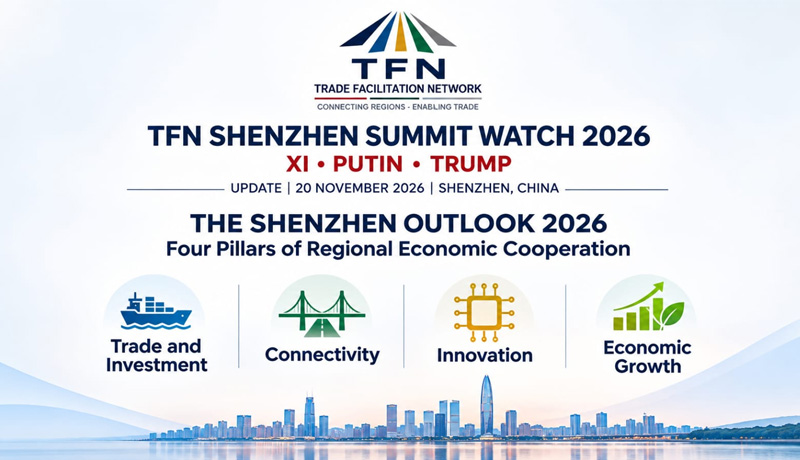
Trade, connectivity, innovation and sustainable economic growth form the foundation of a new regional cooperation framework adopted at the 33rd APEC Economic Leaders’ Meeting.
BRUSSELS/SHENZHEN, (Unib Rashid) – The 33rd APEC Economic Leaders’ Meeting in Shenzhen has adopted a new regional cooperation framework outlining four major priorities for strengthening economic integration and promoting sustainable growth across the Asia-Pacific region.
Titled Building an Asia-Pacific Community to Prosper Together, the 2026 APEC Leaders’ Shenzhen Outlook was adopted during the November 18–19 summit. Guided by the APEC Putrajaya Vision 2040 and China’s 2026 priorities of Openness, Innovation and Cooperation, the framework aims to build an open, dynamic, resilient and peaceful Asia-Pacific community.
The Outlook identifies four interconnected pillars – trade and investment, connectivity, innovation, and economic growth – as essential to strengthening regional competitiveness and ensuring broader participation in economic development.
It also highlights that regional prosperity requires more than trade liberalisation, calling for coordinated efforts in infrastructure development, institutional cooperation, digital transformation and productive capacity.
Trade and Investment: Strengthening Regional Integration
Under the first pillar, APEC leaders reaffirmed their commitment to improving the regional trade and investment environment, strengthening supply-chain resilience and advancing economic integration.
The Outlook supports continued progress towards the Free Trade Area of the Asia-Pacific (FTAAP), alongside initiatives aimed at helping member economies participate in comprehensive and high-standard regional trade arrangements.
Leaders also welcomed the APEC Trade Digitalization Cooperation Framework for 2027–2030, which seeks to promote paperless trade, cross-border e-commerce, electronic documentation and the wider adoption of digital technologies in international commerce.
Other priorities include improving market access, protecting intellectual property, strengthening services trade and enhancing the competitiveness of digitally delivered services.
The Trade Facilitation Network (TFN), an independent research and policy forum, considers digital trade cooperation particularly significant, arguing that modern trade competitiveness increasingly depends on efficient customs procedures, regulatory transparency, electronic payments and interoperable digital systems.
Connectivity: Beyond Roads, Ports and Railways
The second pillar focuses on developing integrated transport networks while removing institutional and administrative barriers that restrict regional trade.
The APEC Connectivity Blueprint identifies three key dimensions: physical, institutional and people-to-people connectivity.
Physical connectivity covers the development and modernisation of road, rail, maritime and air transport networks, alongside energy and digital infrastructure.
Institutional connectivity focuses on customs modernisation, automated border procedures, regulatory cooperation, risk management and streamlined clearance systems to reduce delays and administrative costs.
People-to-people connectivity includes business mobility, tourism, education, vocational training, digital literacy and workforce development. It also highlights the importance of enabling micro, small and medium-sized enterprises (MSMEs) to participate in regional and international value chains.
The Outlook further stresses the need to maintain open trade corridors, strengthen supply-chain resilience and address logistical bottlenecks that could disrupt the movement of essential goods, particularly energy supplies.
According to TFN’s assessment, transport infrastructure alone cannot guarantee effective economic connectivity. Efficient customs procedures, coordinated regulations, digital documentation and commercially viable logistics services are equally important in making international corridors productive.
Innovation: Digital Transformation and Emerging Technologies
The third pillar recognises technological innovation as a major driver of productivity, economic competitiveness and long-term development.
APEC leaders called for stronger regional cooperation in science, technology and innovation, with particular attention to expanding the digital economy and ensuring that the benefits of technological progress reach all sections of society.
Key priorities include improving digital infrastructure, addressing urban-rural digital divides, strengthening technical skills, facilitating secure cross-border data flows and protecting personal information.
The framework also encourages the adoption of digital technologies across manufacturing, agriculture, energy, transport, logistics and services.
Leaders endorsed the APEC Statement on Harnessing Digital and Emerging Technologies for Employment and Prosperity in the Asia-Pacific Region and recognised ongoing work under the APEC AI Initiative 2026–2030.
At the same time, the Outlook acknowledges growing concerns surrounding data breaches, online fraud and the malicious use of emerging technologies.
TFN’s assessment highlights the practical importance of digital innovation in international trade, including electronic customs systems, digital waybills, secure data exchange, electronic invoicing and cross-border payment platforms.
It argues that technological advancement must deliver accessible and affordable solutions, particularly for smaller businesses and developing economies, rather than creating additional barriers to participation.
Economic Growth: Energy Security, Skills and Business Development
The fourth pillar addresses the broader economic and social conditions necessary for sustainable regional prosperity.
The Shenzhen Outlook identifies workforce development, macroeconomic stability, energy security, food security and support for smaller businesses as essential components of long-term economic growth.
It calls for investment in vocational education, lifelong learning, reskilling and upskilling to prepare workers for technological and demographic changes. The framework also emphasises decent employment and the protection of workers’ rights.
On economic stability, APEC encourages credible and flexible fiscal, monetary and financial policies to manage economic shocks, strengthen financial access and address global economic imbalances.
Energy security is another major priority, with the Outlook highlighting cooperation on reliable energy supplies, cross-border infrastructure and supply-chain resilience. It also recognises that individual economies will determine their energy mix according to their domestic priorities.
In agriculture, the framework promotes innovation, digitalisation, improved productivity, food safety and measures to reduce food loss and waste.
It also addresses sustainable management of natural resources, including forest conservation, marine protection and efforts to combat illegal, unreported and unregulated fishing.
Particular attention has been given to micro, small and medium-sized enterprises, with calls to improve their access to finance, technology, skills and international markets.
The Outlook further recognises corruption as a serious obstacle to economic development, public trust and fair competition, encouraging stronger institutional integrity and international cooperation.
Four Pillars Form an Interconnected Economic Strategy
Although presented as four separate areas, the priorities are closely linked and collectively form a broader framework for regional economic development.
Trade and investment create opportunities for market expansion, while connectivity enables the movement of goods, services, capital and people. Innovation improves productivity and competitiveness, and sustainable economic growth provides the financial, institutional and human resources needed to support these developments.
The TFN assessment emphasises that progress in one area cannot deliver its full potential without improvements in the others.
For example, transport corridors require efficient border procedures to function effectively, while digital systems need institutional cooperation to avoid fragmented processes. Similarly, trade liberalisation must be accompanied by stronger productive capacity if its benefits are to reach businesses and communities more widely.
Implementation Will Determine the Outlook’s Success
The Shenzhen Outlook represents a broad policy agenda extending beyond traditional trade liberalisation towards the integrated development of markets, infrastructure, institutions and technology.
TFN has identified three areas that will be particularly important in assessing its implementation: institutional connectivity, the digital transformation of international trade, and the participation of smaller businesses in regional economic integration.
The network said it would monitor progress in four areas, including the FTAAP agenda and trade digitalisation, implementation of the APEC Connectivity Blueprint, cooperation on artificial intelligence and emerging technologies, and developments in energy security, food security and workforce participation.
Particular attention will be given to whether the commitments translate into measurable improvements in trade efficiency, transport connectivity and business opportunities.
However, the Outlook’s implementation will depend on national capacities, practical cooperation and sustained engagement among governments, businesses and regional institutions.
APEC’s cooperation framework remains voluntary, non-binding and consensus-based, meaning that the practical impact of its commitments will ultimately depend on the actions taken by individual member economies.
A New Direction for Regional Economic Cooperation
The 2026 Shenzhen Outlook reflects an evolving understanding of the foundations of international trade and economic competitiveness.
Market access alone is no longer sufficient to guarantee economic success. The ability to connect infrastructure, modernise institutions, adopt new technologies and enable businesses to compete will increasingly determine the region’s economic prospects.
The four pillars provide a framework for advancing this transformation, with the challenge now shifting from policy commitments to practical implementation.
The future of Asia-Pacific economic cooperation will depend on how effectively regional economies translate these priorities into stronger trade links, resilient supply chains, greater innovation and inclusive economic opportunities.
Source: 2026 APEC Leaders’ Shenzhen Outlook; APEC Trade Digitalization Cooperation Framework (2027–2030); APEC Connectivity Blueprint; Trade Facilitation Network (TFN) policy assessment.
Trade Facilitation Network (TFN) – Independent Research & Policy Forum
Leave a Reply
You must be logged in to post a comment.