

Pakistan’s political landscape is once again witnessing a significant shift. Old political rivals are exploring common ground, alliances are being reconsidered, and previously sidelined leaders are returning to the centre of political consultations. Among them is Maulana Fazlur Rehman, Ameer of Jamiat Ulema-e-Islam (F), whose renewed political engagement has attracted considerable national attention.
The recent rapprochement between Pakistan Tehreek-e-Insaf (PTI) and JUI-F is particularly noteworthy. Historically, the two parties have been political competitors, especially in Khyber Pakhtunkhwa. However, changing circumstances have brought them closer. On 4 November, opposition leaders met Maulana Fazlur Rehman at his Islamabad residence to discuss constitutional supremacy, democratic rights and political coordination. PTI founder Imran Khan has also reportedly directed his party to expand political engagement with Maulana Fazlur Rehman and other opposition groups.
This development raises an important question: are we witnessing a genuine consensus on national issues or another temporary adjustment dictated by political convenience?
Maulana Fazlur Rehman is an experienced political leader whose political relevance has endured through successive governments and changing alliances. His ability to maintain communication with competing political forces is an established feature of his career. His renewed engagement deserves attention, but its real significance will depend on whether it produces a principled political understanding or simply another arrangement for political survival.
Unfortunately, Pakistan’s politics has increasingly become a contest of personalities, egos and power. Leaders who passionately advocate democracy, constitutional supremacy and institutional independence while in opposition often struggle to demonstrate the same commitment when they come into government. Political positions change with circumstances, while national interests are frequently pushed into the background.
This contradiction lies at the heart of Pakistan’s political crisis. Governments and opposition parties increasingly treat each other as permanent enemies rather than competing representatives of the same electorate. Political transitions bring fresh accusations, investigations, allegations of victimisation and institutional confrontations. Instead of strengthening democratic institutions, political energies are consumed by attempts to undermine opponents and retain or regain power.
Can such a political culture deliver sustainable governance? Certainly not.
Pakistan faces serious economic, security, educational and institutional challenges. Inflation, unemployment, mounting public debt, declining purchasing power and inadequate public services demand continuity of policies and collective national effort. Investors need confidence, businesses need stability and citizens need opportunities. None of these objectives can be achieved in an atmosphere of perpetual political hostility.
The situation is particularly concerning for Khyber Pakhtunkhwa, where security challenges, economic uncertainty and political instability continue to affect ordinary citizens. Disagreements over provincial authority, governance and constitutional arrangements must be resolved through Parliament and meaningful dialogue rather than further confrontation.
An equally important question concerns the government’s responsibility. The primary role of a government should be to bridge political differences, not deepen them. It must unite the country, accommodate legitimate dissent, restore political confidence and create an environment in which opponents can work together on national priorities. Having greater institutional authority, the government carries a special responsibility to initiate reconciliation.
Political opponents are not enemies of the country; they are stakeholders in its democratic system. Criticism should not be treated as hostility towards the state, nor should political disagreement become a justification for exclusion or retaliation. A government that cannot tolerate dissent or accommodate opposition risks weakening the very democratic institutions it is responsible for protecting.
The opposition, too, must act responsibly. Opposing every government decision is no substitute for presenting workable alternatives. Similarly, the government cannot expect stability by treating every criticism as an attempt to destabilise the country. Both sides must recognise that political differences are legitimate, but permanent confrontation serves neither democracy nor the public.
The role of state institutions also deserves serious consideration. Lasting political stability requires respect for constitutional responsibilities and institutional boundaries. Every institution must operate within its lawful mandate, and the authority to govern must ultimately derive from the Constitution and the freely expressed will of the people.
The emerging political understanding between PTI, JUI-F and other opposition groups should therefore be judged by its objectives, not merely by the possibility of forming another alliance. If it promotes constitutional supremacy, credible elections, parliamentary sovereignty, provincial autonomy and institutional accountability, it could contribute to democratic stability. If, however, it remains limited to challenging the incumbent government and securing political advantage, the country will witness another political realignment without meaningful improvement in governance.
The most disturbing aspect is the apparent absence of a sustained national effort to address the widening political divide. If every disagreement produces confrontation, every criticism invites retaliation and every negotiation ends in further mistrust, where exactly is Pakistan heading? Who is seriously thinking about the country’s future? Who is concerned about the hardships of ordinary citizens, economic uncertainty, national security and the prospects of coming generations? Does anyone in the corridors of power genuinely appreciate the cost of this endless political confrontation?
Pakistan needs a national political compact rather than another temporary political arrangement. Such an understanding should establish minimum commitments to constitutional governance, economic continuity, electoral credibility, the rule of law, provincial rights, education, healthcare and national security. These commitments must survive changes of governments and political leadership.
Maulana Fazlur Rehman, with his extensive political experience and renewed engagement across political divides, can contribute to such a process. However, no single leader or political party can resolve a crisis that has become systemic. The responsibility rests collectively with the government, opposition, Parliament and all constitutional institutions.
Pakistan has reached a critical juncture. Political differences are natural in a democracy, but permanent political polarisation is no longer a sustainable option. The government must take the initiative to bridge the divide, while the opposition must demonstrate a genuine willingness to participate in meaningful dialogue. Neither can escape responsibility for the country’s future.
Pakistan needs political maturity instead of confrontation, reconciliation instead of retaliation, and national consensus instead of personal and party interests. The country belongs to all its citizens, not to any single party, leader or institution. Its future cannot remain hostage to the political ambitions and rivalries of those entrusted with governing it.
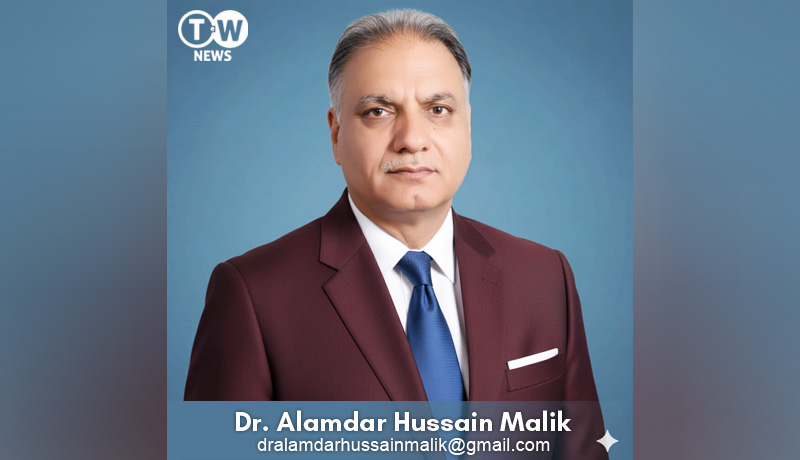
Dr Alamdar Hussain Malik
Former Financial Advisor, Finance Division, Government of Pakistan
Leave a Reply
You must be logged in to post a comment.