

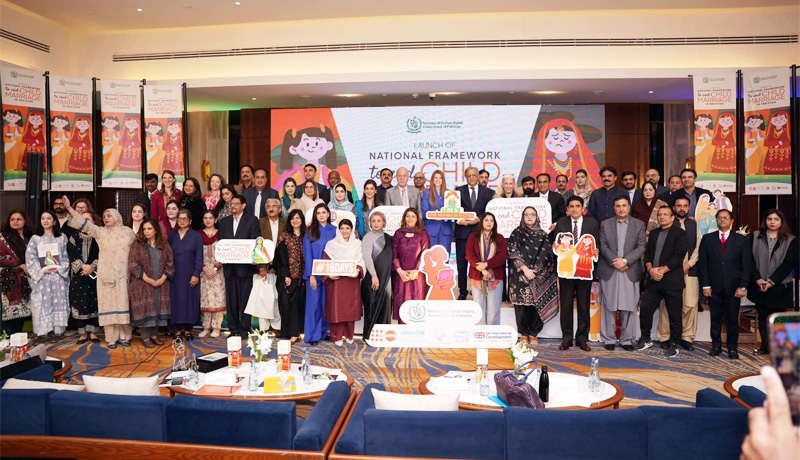
National Framework 2027–2031 aims to strengthen legislation, protect girls’ rights, improve enforcement and coordinate efforts across federal and provincial governments.
BRUSSELS/ISLAMABAD, (Unib Rashid) – Pakistan has launched a five-year National Framework to End Child Marriage, outlining a coordinated national strategy to prevent underage marriages, strengthen legal protections, empower girls and improve institutional accountability.
Federal Minister for Law, Justice and Human Rights Senator Azam Nazeer Tarar inaugurated the National Framework 2027–2031 on Friday, reaffirming the government’s commitment to stronger legislation, effective enforcement and international cooperation to protect children.
Addressing the launch ceremony, Tarar described ending child marriage as a key government priority, stressing that legislative commitments must translate into practical measures and effective implementation across the country.
He reiterated the government’s commitment to implementing the minimum marriage age of 18 years throughout Pakistan, warning that violations of the law would have legal consequences.
Child Marriage Laws Not Contrary to Shariah
Addressing religious concerns surrounding legislation on child marriage, the minister clarified that laws aimed at preventing the practice were not contrary to Shariah.
Referring to the Sindh Child Marriage Restraint Act 2013, Tarar noted that the legislation had been challenged before the Federal Shariat Court, which upheld the law.
He emphasized that the legal provisions were binding and called for stronger enforcement to ensure that their objectives were achieved.
Pakistan Seeks International Cooperation Through OIC
The minister also announced plans to promote international cooperation against child marriage under Pakistan’s chairmanship of the Organization of Islamic Cooperation (OIC).
He said Pakistan would particularly seek collaboration with African countries through joint working groups to exchange experiences, share effective strategies and strengthen collective efforts to address the issue.
Tarar appreciated initiatives taken by the governments of Punjab and Balochistan to tackle child marriage, while emphasizing the need for greater progress and coordination among all provinces.
Five-Year National Roadmap for 2027–2031
Developed by the Ministry of Human Rights with technical support from the United Nations Population Fund (UNFPA) and the United Nations Children’s Fund (UNICEF), the National Framework 2027–2031 provides a common roadmap for federal, provincial and territorial governments.
The framework identifies several priority areas, including:
- Strengthening legislation and enforcement mechanisms.
- Preventing child marriages through coordinated interventions.
- Improving child protection and support services.
- Empowering girls through education and greater opportunities.
- Engaging families and communities to change harmful social practices.
- Enhancing institutional accountability and coordination.
The initiative aims to bring government institutions, development partners and relevant stakeholders together under a comprehensive national strategy to accelerate efforts towards ending child marriage.
UN Agencies and Diplomats Call for Effective Implementation
The launch ceremony was also addressed by Secretary of the Ministry of Human Rights Abdul Khalique Shaikh, UNFPA Representative in Pakistan Dr Luay Shabaneh, UNICEF Representative Pernille Ironside and British High Commissioner Jane Marriott.
The speakers highlighted the importance of translating the national framework into concrete action, emphasizing effective implementation, institutional coordination and sustained cooperation among relevant stakeholders.
During the ceremony, the Ministry of Human Rights also recognized Champions of Change for their contributions to protecting children from child marriage.
The Ministry, UNFPA and UNICEF acknowledged Group Development Pakistan for its support in developing and validating the national framework.
‘A Girl Needs More Than Just Rescue’
Speaking at the event, Sara Ahmed, Chairperson of the Child Protection and Welfare Bureau, highlighted the need to change societal attitudes towards girls and the way their achievements are celebrated.
She questioned the practice of treating girls’ marriages as a major social achievement, suggesting that educational milestones, particularly graduation ceremonies, should instead receive greater recognition.
“I feel personally, rather than spending so much and celebrating marriages, and keeping that as a benchmark for some achievement, a girl’s graduation ceremony should be a benchmark for celebration,” she said.
Emphasizing that protecting girls requires more than simply rescuing them from child marriage, Ahmed said they needed a safe environment, education, healthcare, psychosocial support and opportunities to rebuild their lives.
The launch of the five-year framework marks an important policy step towards addressing child marriage in Pakistan. Its success, however, will depend on effective enforcement, sustained institutional commitment and the active participation of communities to ensure that every girl can access education, protection and opportunities for a better future.
Leave a Reply
You must be logged in to post a comment.