

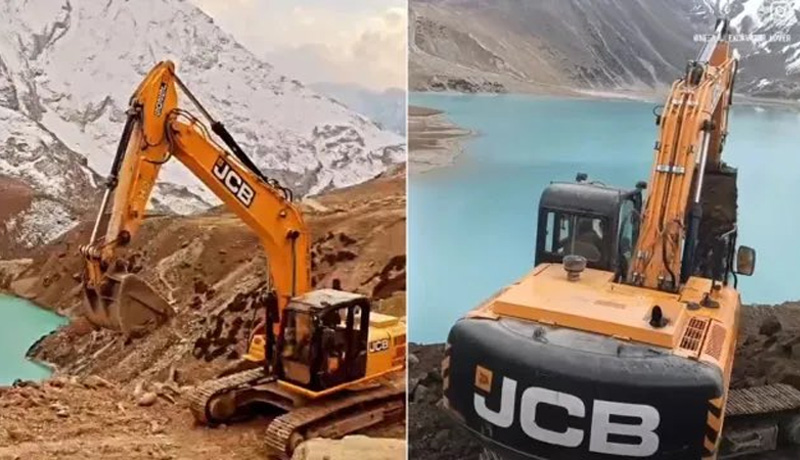
BRUSSELS/ISLAMABAD, (Unib Rashid) – Chairman of the Kashmir Institute of International Relations (KIIR), Altaf Hussain Wani, has expressed serious concern over excavation and the use of heavy machinery near Sheshnag Lake in Indian-administered Jammu and Kashmir, warning that construction activities in the ecologically fragile Himalayan region could have far-reaching environmental consequences.
In a post on social media platform X, Wani strongly criticised the Indian government’s approach to development in the sensitive Himalayan landscape, describing the excavation near Sheshnag Lake as a potentially dangerous intervention rather than a development initiative.
“The Indian Govt is playing a lethal game of Russian Roulette with the Himalayas. The excavation at Sheshnag Lake isn’t ‘development’—it is a blueprint for an ecological apocalypse,” Wani wrote.
His remarks come amid growing controversy over videos circulating on social media showing heavy earth-moving machinery operating near the high-altitude glacial lake along the traditional Amarnath pilgrimage route.
Situated at an altitude of approximately 3,590 metres, Sheshnag Lake is part of a sensitive Himalayan ecosystem. Environmental concerns have intensified because the lake is surrounded by steep slopes and loose glacial deposits, making the surrounding terrain particularly vulnerable to disturbance.
The controversy has also drawn criticism from political leaders, environmental activists and religious representatives, who have questioned the need for heavy machinery in such an environmentally sensitive location and called for greater transparency regarding the work.
The Border Roads Organisation (BRO), which is carrying out the work, has maintained that the activity is part of post-Amarnath Yatra track-widening and stabilisation operations. In its clarification, the organisation said the work was confined to existing tracks and that measures were being taken to minimise disturbance to the surrounding terrain, ensure safe disposal of excavated material and protect natural drainage.
However, concerns remain over whether the environmental implications of the activity have been adequately assessed and whether independent scientific monitoring is required before further work proceeds.
Sheshnag is among the high-risk glacial lakes identified in Jammu and Kashmir, making environmental protection in its surrounding area particularly important. Any disturbance to the fragile mountain ecosystem warrants careful scientific assessment, given the potential implications for downstream communities and water systems.
Wani’s warning has added to wider calls for responsible development in the Himalayan region, where infrastructure improvements must be balanced against ecological sustainability and disaster-risk reduction.
Environmental experts and concerned voices have repeatedly stressed the importance of protecting glaciers, mountain slopes and high-altitude water bodies from unplanned construction and potentially damaging human interventions.
The debate surrounding Sheshnag Lake has therefore raised a broader question: how can infrastructure and pilgrimage facilities be improved without compromising the environmental security of one of the world’s most fragile mountain ecosystems?
Leave a Reply
You must be logged in to post a comment.